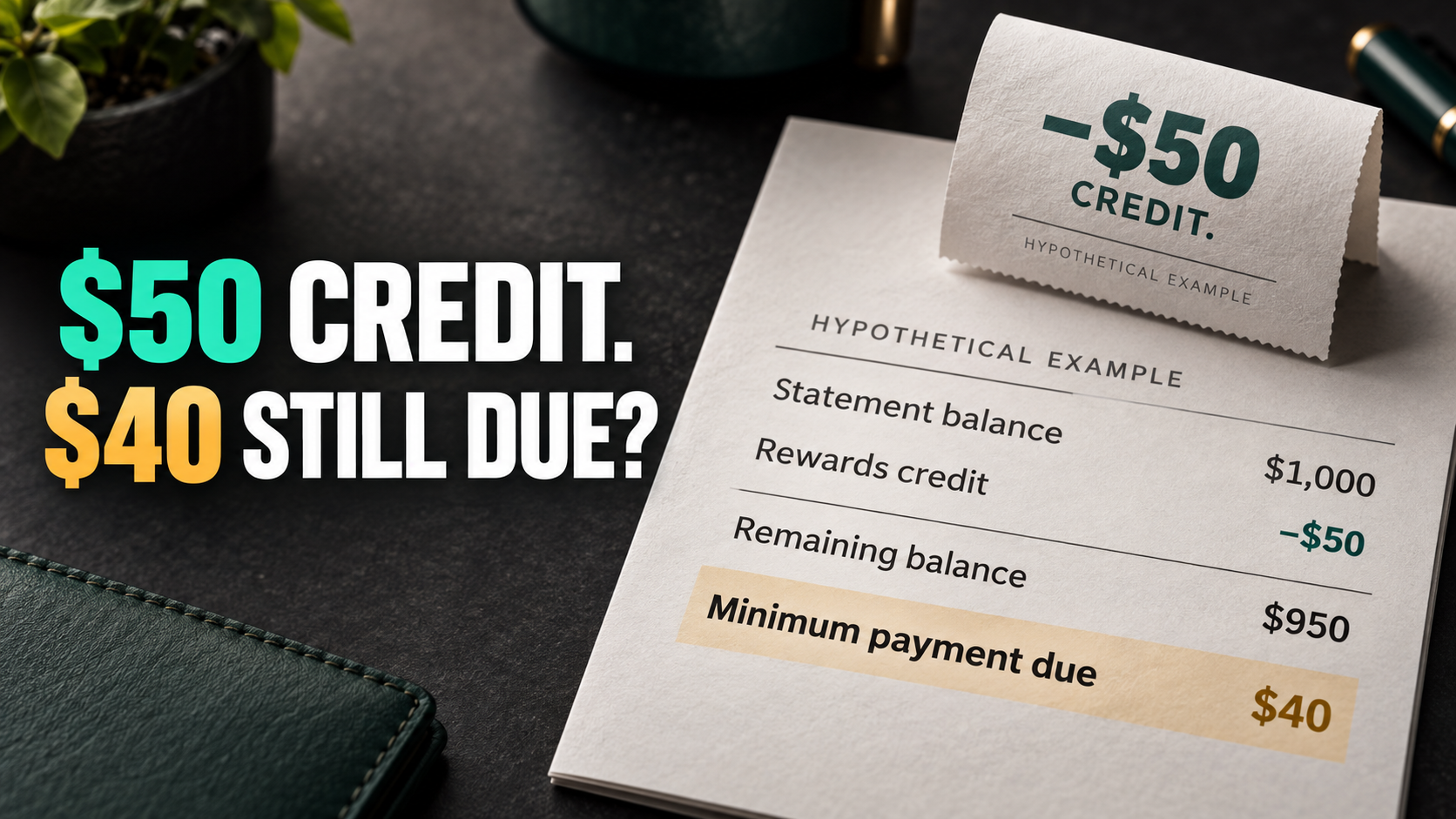
A $50 rewards credit and a $40 minimum payment? Do not assume the bill is handled—a credit can reduce your balance while leaving that minimum payment due.
Chase’s educational guidance says rewards statement credits typically do not count toward the required minimum. A smaller balance is useful. It is not a payment confirmation.
Source: https://www.chase.com/personal/credit-cards/education/rewards-benefits/pay-credit-card-with-reward-points
The hypothetical math: $950 remains, $40 is due
Consider a hypothetical Chase Sapphire Preferred account governed by the linked Ultimate Rewards program agreement: a $1,000 statement balance and a $40 minimum payment. A $50 rewards statement credit is applied after the statement closes and before the payment due date, with no other payments or credits.
Hypothetical statement-credit example
After the credit, $950 of the original statement balance remains unpaid. Under this agreement, the required payment is the lesser of the minimum or the remaining statement balance—so $40 is still due.
The catch—and the limited exception
The agreement’s Cash section makes an exception when credits and payments applied between statement close and the due date equal or exceed the statement balance. In that case, no additional payment is required to satisfy this rule; otherwise, the lesser-of requirement applies.
This is the linked agreement’s rule, not a promise about every issuer or rewards program.
Source: https://asset.chase.com/content/dam/card/rulesregulations/en/RPA0444_0477.pdf
Check the account before calling it paid
A statement credit lowers your balance, as Chase’s statement-credit explainer describes. In our hypothetical example, paying the $40 minimum would not pay off the remaining statement balance—and meeting a minimum is not a guarantee of avoiding interest.
Source: https://www.chase.com/personal/credit-cards/education/rewards-benefits/what-is-a-statement-credit
- Confirm that the rewards credit has actually posted.
- Check the remaining statement balance, minimum amount due, and payment due date.
- If you use autopay, verify the scheduled payment rather than assuming it adjusted.
- If anything is unclear, ask your issuer what payment is still required and what amount is needed to avoid interest under your account terms.
For more rewards basics, visit our free learning center: https://practicalrewards.com/learning.html
Practical verdict
Use statement credits to reduce what you owe. Skip the assumption that redeeming rewards finishes the payment task: confirm the posted credit, then make the payment your account still requires by its due date.