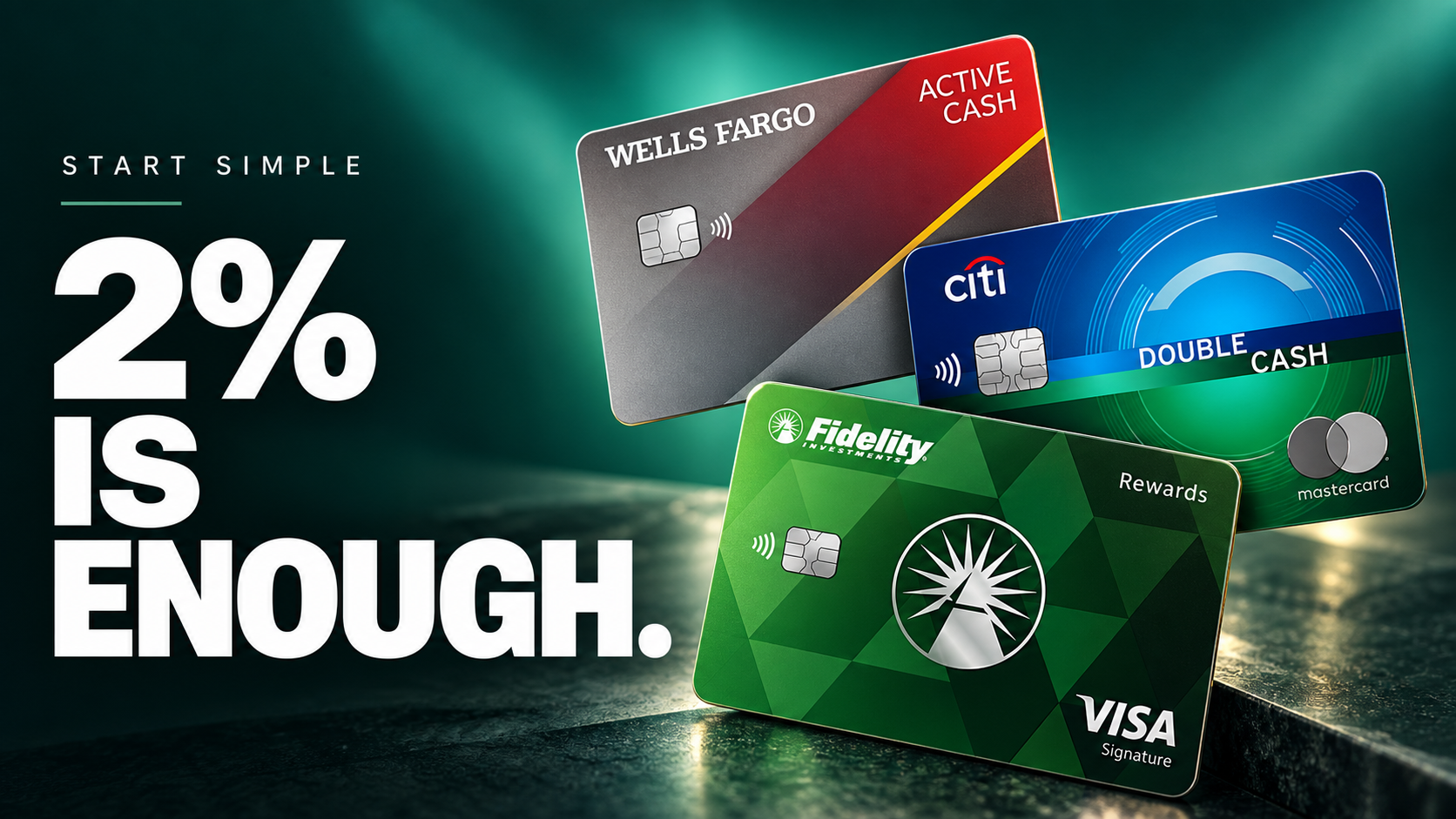
Start with a flat 2% card. It is the practical foundation for almost any rewards strategy—and, for many people, the finish line.
First decide whether the goal is cash back or travel rewards. Then choose a card that earns at least 2% back or 2x points on ordinary spending. Anything lower is money left behind when a $0-fee 2% option is available.
Why 2% can beat a badly run 5% strategy
A higher headline rate does not guarantee higher total rewards. What matters is how much spending actually earns that rate—and what happens to everything else.
In a hypothetical year with $10,000 of spending, assume $1,000 earns 5% and the remaining $9,000 earns 1%. That strategy produces $140, while putting the same hypothetical $10,000 on a flat 2% card produces $200.
Hypothetical annual rewards
The flat-rate card wins by $60 under those hypothetical assumptions. A well-run category strategy can do better, but an imaginary 5% that rarely reaches the register earns nothing. Banks keep it complicated; the default card keeps it practical.
Consistency has value
A flat-rate card removes three recurring questions: which card to use, whether a purchase fits a category, and whether the extra reward is worth the brain space.
That consistency is especially useful for spending outside obvious bonus categories. The card can also remain the catch-all if more specialized cards join the wallet later.
Choose cash back or travel points first
Cash back is the plain-English lane: 2% back has a direct dollar meaning. Travel points require one extra step because 2x points does not automatically equal 2% back—the result depends on what those points return when redeemed.
If travel is the goal, look for a flat-rate travel card that earns at least 2x on ordinary spending, then use the Practical Rewards points-and-miles learning guides to understand redemptions before choosing an ecosystem. The supplied card list does not include the travel cards needed for a specific recommendation here, so we will not guess at their terms.
For cash back, the Wells Fargo Active Cash® offers unlimited 2% cash rewards with a $0 annual fee. The Citi Double Cash® Card also has a $0 annual fee and earns 2% on everything through a split structure: 1% when buying and 1% when paying.
The Fidelity® Rewards Visa Signature® Card has a $0 annual fee and earns 2x on everything else. Its supplied guidance describes it as a simple 2% card best aligned with redemption into a Fidelity account—which is useful alignment for some people and needless friction for others.
| Card | Everyday rate | Practical fit |
|---|---|---|
| Wells Fargo Active Cash® | Unlimited 2% cash rewards | Brain-off cash rewards |
| Citi Double Cash® Card | 2% total: 1% when buying and 1% when paying | Simple cash back with split earning mechanics |
| Fidelity® Rewards Visa Signature® Card | 2x on everything else | Best aligned with a Fidelity account |
These published reward terms do not establish approval odds, so there is no basis here for treating a lower earning rate as an easier-approval shortcut. Compare the offers actually available to you, but keep 2% as the target.
Do not settle for 1.5% on ordinary spending
The Capital One Quicksilver Cash Rewards Credit Card earns 1.5% on everything and has a $0 annual fee. That is not the general-spending recommendation here: the supplied options already include multiple $0-fee cards earning 2% or 2x on ordinary spending.
On a hypothetical $10,000 of spending, 1.5% produces $150 while 2% produces $200. The $50 difference is money left behind for doing the same spending.
The catch
A 2% card is useful only when rewards do not encourage extra purchases. On a hypothetical $100 purchase, 2% returns $2; the other $98 still came out of the budget. The bank has not misplaced its calculator.
When one card is enough
Keep the single-card setup when simplicity matters more than squeezing a little more from selected purchases. There is no prize for carrying five cards if the extra categories go unused.
Add another card only when a meaningful amount of existing, organic spending would earn more and its rules are easy enough to follow. The flat 2% card then remains the catch-all for everything the specialized card does not cover.
Practical verdict
Choose a $0-fee 2% card if straightforward cash back is the goal. If travel is the goal, choose a flat-rate points card only after understanding how its points are redeemed. Skip the multi-card strategy until real spending justifies the extra work—and do not send ordinary spending to a card earning less than 2% when a 2% catch-all is available.